Saturday, December 11, 2010

Thursday, December 2, 2010
Cats Playing Patty-cake, what they were saying...
Funny...and not in any way related to anything we read this semester!
Wednesday, November 17, 2010
Class Canceled, 11/18
Class is canceled tomorrow, 11/18. Please relay this to as many students as you can.
Send your freewriting to me via email or drop off at my office G 108.
Thanks,
Prof. Hebert
Send your freewriting to me via email or drop off at my office G 108.
Thanks,
Prof. Hebert
Friday, November 5, 2010
Abbey Lincoln: Throw It Away
The poet, the singer, of my Friday morning rainy day.
Maybe you'll like the words too.
Tuesday, November 2, 2010
Amended Course Schedule
Read the following very carefully.
Lit 201 HA Schedule
The class schedule listed below is the amended schedule for the rest of the semester. Note: Due dates for research paper assignments as listed on The Yellow Wallpaper research paper hand out. Also note: The final exam has been canceled. The final research paper will weigh more as a result. Make sure to get started now, and to complete all stages of the research paper requirements in order to receive a good final grade.
Week 9
10/28
*** List of reliable scholarly sources (minimum 4) in MLA format
Week 10
11/4
Elements of Poetry: Images/Sound/Meter
Modern Poetry: Celebration of the So-called Ordinary
Emily Dickinson, I Felt a Funeral, in my Brain,, Much Madness is divinest Sense, I heard a Fly buzz – when I died, Because I could not stop for Death (534-537))
William Carlos Williams, excerpt from Paterson (handout)
Langston Hughes, The Negro Speaks of Rivers (handout), Harlem (577)
Pablo Neruda, (handout)
Robert Frost, The Road Not Taken (550)
Sylvia Plath, Daddy (632)
Journal question: Read the poems listed above aloud, if possible. Poems are meant to be heard, like music. After, choose several poems you enjoy or are interested in. Your journal should be about your response to the poems and why you feel what you do, as well as what you think the poet is saying/feeling.
Week 11
11/11
Modern Poetry: Social Commentary and the Subversive
Sonia Sanchez (handout)
Paul Lawrence Dunbar, We Wear the Mask (548)
Adrienne Rich, Diving into the Wreck (624)
Walt Whitman, From Song of Myself (519)
A selection of Nuyorican poets: Miguel Algarin, Maggie Estep and others (handout)
Pablo Neruda, (handout)
Allen Ginsberg., A Supermarket in California (608)
Recording of Ginsberg’s Howl (provided in class)
Journal question: Read the poems listed above aloud, if possible. Poems are meant to be heard, like music. After, choose several poems you enjoy or are interested in. Your journal should be about your response to the poems and why you feel what you do, as well as what you think the poet is saying/feeling.
Week 12
11/18
Modern Poetry: Religion to Surrealism
Gerald Manley Hopkins, God’s Grandeur (540), Pied Beauty (540), Spring and Fall (541)
Anne Waldman, Make up on Empty Space go to http://www.poetspath.com/AWaldman/Empty_Space.htm
Charles Baudelaire, (handout)
Wallace Steven, The Emperor of Ice Cream, Disillusionment of Ten O’Clock (556-557)
James Tate, The Wheelchair Butterfly (667)
Other poets to be announced.
Assignment: Read the poems listed above aloud, if possible. Poems are meant to be heard, like music. Be prepared to discuss.
***Research paper freewrite due
Week 13
11/25
No class - Thanksgiving
Week 14
12/2
Greek Drama
Sophocles, Antigone (handout)
Reading and writing assignment to be announced.
Week 15
12/9
Antigone continued
Week 16
12/16
Research paper due
Film: Frida
Lit 201 HA Schedule
The class schedule listed below is the amended schedule for the rest of the semester. Note: Due dates for research paper assignments as listed on The Yellow Wallpaper research paper hand out. Also note: The final exam has been canceled. The final research paper will weigh more as a result. Make sure to get started now, and to complete all stages of the research paper requirements in order to receive a good final grade.
Week 9
10/28
*** List of reliable scholarly sources (minimum 4) in MLA format
Week 10
11/4
Elements of Poetry: Images/Sound/Meter
Modern Poetry: Celebration of the So-called Ordinary
Emily Dickinson, I Felt a Funeral, in my Brain,, Much Madness is divinest Sense, I heard a Fly buzz – when I died, Because I could not stop for Death (534-537))
William Carlos Williams, excerpt from Paterson (handout)
Langston Hughes, The Negro Speaks of Rivers (handout), Harlem (577)
Pablo Neruda, (handout)
Robert Frost, The Road Not Taken (550)
Sylvia Plath, Daddy (632)
Journal question: Read the poems listed above aloud, if possible. Poems are meant to be heard, like music. After, choose several poems you enjoy or are interested in. Your journal should be about your response to the poems and why you feel what you do, as well as what you think the poet is saying/feeling.
Week 11
11/11
Modern Poetry: Social Commentary and the Subversive
Sonia Sanchez (handout)
Paul Lawrence Dunbar, We Wear the Mask (548)
Adrienne Rich, Diving into the Wreck (624)
Walt Whitman, From Song of Myself (519)
A selection of Nuyorican poets: Miguel Algarin, Maggie Estep and others (handout)
Pablo Neruda, (handout)
Allen Ginsberg., A Supermarket in California (608)
Recording of Ginsberg’s Howl (provided in class)
Journal question: Read the poems listed above aloud, if possible. Poems are meant to be heard, like music. After, choose several poems you enjoy or are interested in. Your journal should be about your response to the poems and why you feel what you do, as well as what you think the poet is saying/feeling.
Week 12
11/18
Modern Poetry: Religion to Surrealism
Gerald Manley Hopkins, God’s Grandeur (540), Pied Beauty (540), Spring and Fall (541)
Anne Waldman, Make up on Empty Space go to http://www.poetspath.com/AWaldman/Empty_Space.htm
Charles Baudelaire, (handout)
Wallace Steven, The Emperor of Ice Cream, Disillusionment of Ten O’Clock (556-557)
James Tate, The Wheelchair Butterfly (667)
Other poets to be announced.
Assignment: Read the poems listed above aloud, if possible. Poems are meant to be heard, like music. Be prepared to discuss.
***Research paper freewrite due
Week 13
11/25
No class - Thanksgiving
Week 14
12/2
Greek Drama
Sophocles, Antigone (handout)
Reading and writing assignment to be announced.
Week 15
12/9
Antigone continued
Week 16
12/16
Research paper due
Film: Frida
Friday, October 22, 2010
Cup of tea.....or coffee?
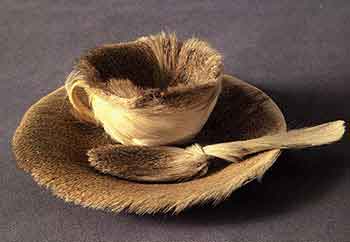
Meret Oppenheim, Object, Paris, 1936
Maybe this is a cup Gregor might like?
Reading Kafka could make you smarter
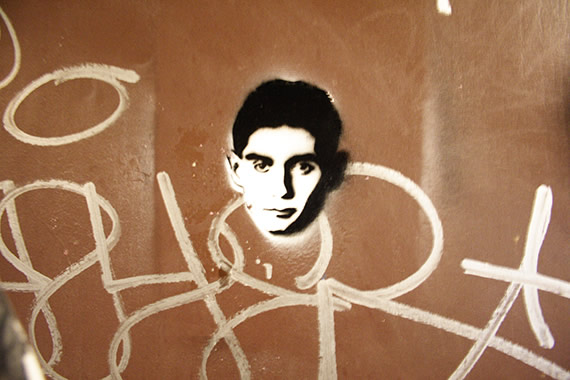
Science Daily (Sept. 16, 2009)-- Reading a book by Franz Kafka --- or watching a film by director David Lynch--- could make you smarter.
According to research by psychologists at UC Santa Barbara and the University of British Columbia, exposure to the surrealism in, say, Kafka's "The Country Doctor" or Lynch's "Blue Velvet" enhances the cognitive mechanisms that oversee implicit learning functions. The researchers' findings appear in an article published in the September issue of the journal Psychological Science.
"The idea is that when you're exposed to a meaning threat -- something that fundamentally does not make sense -- your brain is going to respond by looking for some other kind of structure within your environment," said Travis Proulx, a postdoctoral researcher at UCSB and co-author of the article. "And, it turns out, that structure can be completely unrelated to the meaning threat."
Meaning, according to Proulx, is an expected association within one's environment. Fire, for example, is associated with extreme heat, and putting your hand in a flame and finding it icy cold would constitute a threat to that meaning. "It would be very disturbing to you because it wouldn't make sense," he said.
As part of their research, Proulx and Steven J. Heine, a professor of psychology at the University of British Columbia and the article's second co-author, asked a group of subjects to read an abridged and slightly edited version of Kafka's "The Country Doctor," which involves a nonsensical -- and in some ways disturbing -- series of events. A second group read a different version of the same short story, one that had been rewritten so that the plot and literary elements made sense. The subjects were then asked to complete an artificial-grammar learning task in which they were exposed to hidden patterns in letter strings. They were asked to copy the individual letter strings and then to put a mark next to those that followed a similar pattern.
"People who read the nonsensical story checked off more letter strings -- clearly they were motivated to find structure," said Proulx. "But what's more important is that they were actually more accurate than those who read the more normal version of the story. They really did learn the pattern better than the other participants did."
In a second study, the same results were evident among people who were led to feel alienated about themselves as they considered how their past actions were often contradictory. "You get the same pattern of effects whether you're reading Kafka or experiencing a breakdown in your sense of identity," Proulx explained. "People feel uncomfortable when their expected associations are violated, and that creates an unconscious desire to make sense of their surroundings. That feeling of discomfort may come from a surreal story, or from contemplating their own contradictory behaviors, but either way, people want to get rid of it. So they're motivated to learn new patterns."
Thus far, the researchers have identified the beneficial effects of unusual experiences only in implicit pattern learning. It remains to be seen whether or not reading surreal literature would aid in the learning of studied material as well. "It's important to note that sitting down with a Kafka story before exam time probably wouldn't boost your performance on a test," said Proulx.
"What is critical here is that our participants were not expecting to encounter this bizarre story," he continued. "If you expect that you'll encounter something strange or out of the ordinary, you won't experience the same sense of alienation. You may be disturbed by it, but you won't show the same learning ability. The key to our study is that our participants were surprised by the series of unexpected events, and they had no way to make sense of them. Hence, they strived to make sense of something else."
Source: Association for Psychological Science (news : web)
Subscribe to:
Posts (Atom)