Friday, October 22, 2010

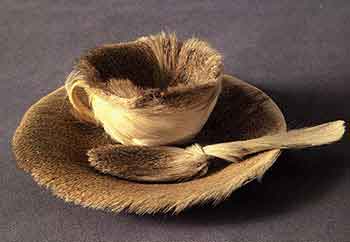
Cup of tea.....or coffee?


Meret Oppenheim, Object, Paris, 1936

Maybe this is a cup Gregor might like?

Reading Kafka could make you smarter


Science Daily (Sept. 16, 2009)-- Reading a book by Franz Kafka --- or watching a film by director David Lynch--- could make you smarter.

According to research by psychologists at UC Santa Barbara and the University of British Columbia, exposure to the surrealism in, say, Kafka's "The Country Doctor" or Lynch's "Blue Velvet" enhances the cognitive mechanisms that oversee implicit learning functions. The researchers' findings appear in an article published in the September issue of the journal Psychological Science.

"The idea is that when you're exposed to a meaning threat -- something that fundamentally does not make sense -- your brain is going to respond by looking for some other kind of structure within your environment," said Travis Proulx, a postdoctoral researcher at UCSB and co-author of the article. "And, it turns out, that structure can be completely unrelated to the meaning threat."

Meaning, according to Proulx, is an expected association within one's environment. Fire, for example, is associated with extreme heat, and putting your hand in a flame and finding it icy cold would constitute a threat to that meaning. "It would be very disturbing to you because it wouldn't make sense," he said.

As part of their research, Proulx and Steven J. Heine, a professor of psychology at the University of British Columbia and the article's second co-author, asked a group of subjects to read an abridged and slightly edited version of Kafka's "The Country Doctor," which involves a nonsensical -- and in some ways disturbing -- series of events. A second group read a different version of the same short story, one that had been rewritten so that the plot and literary elements made sense. The subjects were then asked to complete an artificial-grammar learning task in which they were exposed to hidden patterns in letter strings. They were asked to copy the individual letter strings and then to put a mark next to those that followed a similar pattern.

"People who read the nonsensical story checked off more letter strings -- clearly they were motivated to find structure," said Proulx. "But what's more important is that they were actually more accurate than those who read the more normal version of the story. They really did learn the pattern better than the other participants did."

In a second study, the same results were evident among people who were led to feel alienated about themselves as they considered how their past actions were often contradictory. "You get the same pattern of effects whether you're reading Kafka or experiencing a breakdown in your sense of identity," Proulx explained. "People feel uncomfortable when their expected associations are violated, and that creates an unconscious desire to make sense of their surroundings. That feeling of discomfort may come from a surreal story, or from contemplating their own contradictory behaviors, but either way, people want to get rid of it. So they're motivated to learn new patterns."

Thus far, the researchers have identified the beneficial effects of unusual experiences only in implicit pattern learning. It remains to be seen whether or not reading surreal literature would aid in the learning of studied material as well. "It's important to note that sitting down with a Kafka story before exam time probably wouldn't boost your performance on a test," said Proulx.

"What is critical here is that our participants were not expecting to encounter this bizarre story," he continued. "If you expect that you'll encounter something strange or out of the ordinary, you won't experience the same sense of alienation. You may be disturbed by it, but you won't show the same learning ability. The key to our study is that our participants were surprised by the series of unexpected events, and they had no way to make sense of them. Hence, they strived to make sense of something else."

Source: Association for Psychological Science (news : web)

Thursday, October 7, 2010

The Surreal

Rene Magritte, The Lovers.

In high school I saw this painting and was inspired to write a poem. What do you think of the painting?

Merriam Webster dictionary definition of Surrealism: the principles, ideals, or practice of producing fantastic or incongruous imagery or effects in art, literature, film, or theater by means of unnatural or irrational juxtapositions and combinations

Below is The Empire of Lights also by the French Surrealist, Rene Magritte. Do you notice anything irrational or unnatural? Click on the painting for a full view.


Below is the surrealist painting, Persistence of Time by Salvador Dali. Have you seen this painting before? Click on it for the full painting. It looks like a scene Gregor Samsa might wake up to, if he hadn't already turned into a bug!

The work of Frida Kahlo, a Mexican artist, has often been described as surreal or dream-like. Here is her painting What the Water Gave Me. You decide.


Also by Kahlo, The Two Fridas. Click on image for full painting.

The Violence of Grace

Caravaggio, The Conversion of St. Paul on the Road to Damascus (Click on image for full painting)

On his way to Damascus, Saul is knocked from his horse, blinded for 3 days in a violent moment of conversion captured here by Caravaggio, an Italian artist between 1593 and 1610, considered the first great representative of the Baroque school of painting. This is Flannery O'Connor's grandmother, hat knocked off to one side, legs askew, sitting on the dusty road. Some vacation!

Here is another painting by Caravaggio, The Martyrdom of St. Matthew. Notice how the sword of death is coming, as Matthew reaches to the angel's extended hand. Again, click the image, for the full painting.

Friday, October 1, 2010

Journal responses


I love this image- found it on google images and it fits the purpose of this post.

The following are some of my tips for doing well on journal assignments. I'm going to break it down into the smallest details, because, well, I can. I'm writing a blog post, after all.

First...read the journal question(s) before reading. You're paying attention to everything, annotating as you go, but you want to keep the questions in mind.

After you fully comprehend what you've read, spent time with it, uninterrupted (I don't recommend texting), go back to the journal question.

Next, I recommend freewriting out your thoughts. Some people like typing, others prefer writing in long hand. Write without worry, let your thinking develop by asking yourself questions: Why? How? What do I mean? Where is this in the story? You may recall some quote or instance. Do so without summarizing, as the journal questions
never ask for summary.

You should know by now that if you give a simple explanation, like for example, "Sonny explained what he went through in being addicted to heroin, and his brother had trouble understanding" that you need to go back to the text. You can do much more explaining and exploring, but the author's words themselves will help you get there.
If you look at the exchange the brothers have specifically, thinking about the meaning of what they say to each other, including certain quotes, and your analysis, then you're on your way to doing good work.

I recommend freewriting these thoughts out, and then organizing them into paragraphs, editing out repetition and adding anything more later. And you must, after all this proofread! MUST proofread!

You know the requirement is 2 typed pages double spaced (no additional spaces) and in 12 font. If you do this process, you won't have a problem "filling up" 2 pages.

I'll see you're thinking, taking it on, showing care, and even if your interpretation is not perfect, you engaged and worked.

Remember: interpreting literature is not a matter of opinion with all opinions being correct. What happens in the case of opinion-making regarding literature is that people can then make up their own stories, often conventional ones. They might then fail to listen to the writer, who is often far quirkier and more challenging to understand.

I would welcome your sending me journals every once in a while for review, before passing them in, if you think my feedback would be helpful.